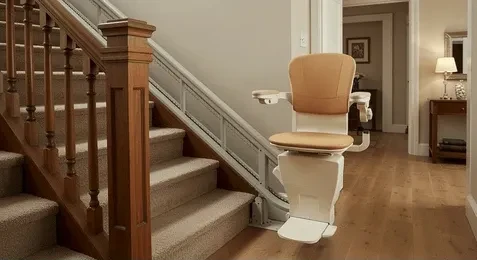
A stairlift fitted inside an ordinary home usually does not need planning permission. Listed buildings are the main exception, because listed building consent may be needed for the fixings. Conservation areas are normally less of a worry for an internal lift. This is general guidance, not legal advice, so check your own situation with the council.
Planning permission: the usual answer
Planning permission is mostly about how a change affects the outside of a property and its surroundings. An internal stairlift sits entirely inside the house and changes nothing about how it looks from the street. The Planning Portal, which is the government-backed planning resource for England and Wales, states that planning permission is not generally required for an internal stairlift. For a standard house, bungalow or flat, you can usually book a survey and go ahead.
Building regulations are separate. In practice a stairlift is satisfied by being installed to the relevant safety standard, BS EN 81-40, which covers rail fixings, obstruction sensors and emergency stops. Ask any installer whether they fit to it.
Listed buildings: the genuine exception
Listing protects the historic character of a building, and that includes the inside. Original staircases, newel posts, handrails and panelling can all be part of what is protected. Councils want oversight of changes that would otherwise be exempt, and that can include the fixings for a stairlift.
So if your home is listed, assume you may need listed building consent before any work, and do not book installation until you have checked. Fitting without consent when it is required can be a serious matter, and the council can require the work to be put right. We say "may" because every listing is different, and the rules depend on the grade and the detail of the listing.
Colchester has plenty of listed homes. The historic town centre has many, as do villages across Dedham Vale. Our page on stairlifts in Dedham covers the sort of older properties we survey in the Vale.
Conservation areas
If your home sits in a conservation area but is not itself listed, an internal stairlift is normally fine, because conservation area controls are mainly about external appearance. The caution is for outdoor lifts, which are visible from outside. If you are looking at an outdoor stairlift in a conservation area, speak to the council first, even though a rail is not normally treated as a new building.
Parts of Colchester are conservation areas. If you are not sure whether yours is one, the council can tell you.
Who to ask
Contact Colchester City Council's planning or conservation team before you book. Tell them:
- the address, and whether the building is listed or in a conservation area;
- that you want to fit an internal stairlift, and where the rail will run;
- that fixings go into the stair treads, which is how most stairlifts are installed.
Ask for their answer in writing. It costs nothing, and it gives you something to show if anyone queries the work later. Do not rely on us, a neighbour or an internet forum to settle a listed building question. The council is the right authority.
How a stairlift can be less intrusive
If consent is needed, the council will care how reversible the work is. A stairlift is one of the more reversible changes you can make. The rail is bolted to the treads, not built into the structure, and when it comes out it leaves small screw holes. Our guide to removing a stairlift explains how that works. Slimmer rails, folding seats and a hinged section at the foot can all reduce the visual impact, and a surveyor can explain the options. A stairlift on narrow period stairs usually needs careful positioning, which is exactly what you would show the council.
If you have a winding or fan staircase, as many period houses do, you will probably need a curved rail. Our guide to straight or curved explains why, and the curved stairlifts page covers the process.
What to put in your enquiry to the council
A clear request gets a clearer answer. It helps to include a few photographs of the staircase, showing the bottom and top steps, the handrail and any original features. Describe the type of stairlift in plain terms, such as a straight or curved lift with the rail on the treads, and say who will use it and why. Mention whether the rail would touch the handrail, newel posts or panelling. If you have a copy of the listing description, include the list entry number.
The council may offer informal advice, ask for more detail, or tell you that a formal application is needed. Allow time for this before your install date, particularly if the lift is for someone leaving hospital. In that situation, tell the council about the urgency, and ask your occupational therapist whether any short term arrangement is possible while you wait. We have more on the options across our stairlift types hub.
Other consents to remember
- Leasehold flats. Your lease may require the freeholder's or management company's permission before anything is fixed to shared stairs. That is a private requirement, not a planning one.
- Rented homes. Speak to your landlord first.
- Insurance. It is sensible to tell your home insurer.
Next step
We survey listed and period homes across Colchester and north Essex, and a surveyor can describe exactly where the fixings go so you have clear information to give the council. Book a free home survey or use the contact page.
Frequently asked questions
Do I need planning permission for a stairlift?
Usually not for an internal stairlift in an ordinary home. Listed buildings are the exception, where listed building consent may be needed. Check with Colchester City Council if you are unsure.
Do I need consent for a stairlift in a conservation area?
An internal stairlift in a conservation area is normally fine because the controls focus on external appearance. An outdoor stairlift is more sensitive, so ask the council first.
Who do I ask about a stairlift in a listed building in Colchester?
Contact the planning or conservation team at Colchester City Council before booking. Ask for the answer in writing.
Will a stairlift damage a period staircase?
Most are fixed to the treads, not the wall, and leave small screw holes when removed. Tell the surveyor about any original features so they can plan the fixings carefully.
listed buildingconservation areaplanning permissionColchester
More in Choosing a stairlift
- Stairlift services: the complete guide
- Heavy Duty Stairlifts: Weight Limits Explained
- New or Reconditioned Stairlift: Which Is Better Value?
- Stairlift Features Checklist: What to Look For
- Stairlift or Home Lift: Which Is Right for Your House?
- Stairlifts for Chalet Bungalows, Bungalows with Loft Rooms and Dormer Homes
- Stairlifts for Narrow Stairs: What Actually Fits?
- Standing and Perching Stairlifts Explained
- Straight or Curved Stairlift: Which Do I Need?