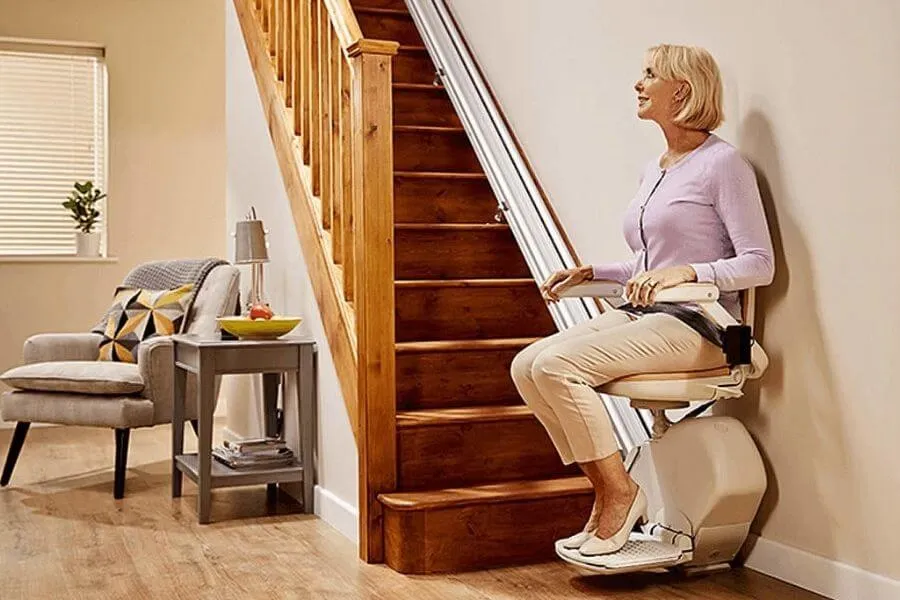
Every stairlift has a maximum user weight. Heavy duty models raise that limit to about 160 kg (25 stone), and a few go higher. If you are near the limit of a standard lift, or the seat simply feels tight, a heavy duty stairlift is the safe and comfortable choice, and it usually costs only a little more.
What the weight limit actually means
The limit on the specification sheet is the maximum load the lift is rated to carry. It covers everything on the seat, not just the person: clothing, shoes, a walking aid, a bag or a laundry basket. Standard stairlifts across the market carry somewhere in the region of 115 kg to 136 kg (roughly 18 to 21 stone), depending on make and model. Those are typical ranges, not promises for any one lift, so always read the figure for the exact model on your quote.
Stairlifts must meet the safety standard BS EN 81-40, and rated load is a core part of it. Stay inside the limit and the motor, drive gear, batteries and rail fixings are working as designed. Go over it and the lift may slow on the climb, drain its batteries faster and wear out sooner. It could also affect your warranty.
What makes a heavy duty stairlift different
It looks much like a standard lift, but the parts that carry load are upgraded.
- A stronger motor and gearbox, to hold a steady speed on the climb.
- A reinforced carriage and rail, to spread the load.
- A wider, deeper and better padded seat.
- Wider or adjustable armrests, so you are not squeezed in.
- A sturdier footrest.
- Higher capacity batteries on some models.
Heavy duty lifts for straight stairs commonly go to about 160 kg (25 stone). Some specialist models carry more, and on curved rails the choice thins out, with fewer models at the top of the range. If you are beyond what a stairlift can carry, a home lift may be the better answer.
Seat width matters as much as weight
Plenty of people well inside a standard limit still find the seat too narrow. A seat that is too tight makes sitting down and standing up harder, and that is when slips happen. At the survey, the surveyor should check the gap between the armrests and the depth of the seat against your build, not just your weight on a scale. If you are between sizes, the wider seat of a heavy duty lift is often worth it for comfort alone.
Working out the right figure
- Use a recent, accurate weight, not a guess from a few years ago.
- Add a margin for clothes, shoes and anything you carry.
- Allow for change. If weight may shift because of a health condition or medication, plan for it.
- If two people share the lift, size it for the heavier one.
A sensible rule of thumb: if the user is within about 10 kg of a standard lift's limit, look at heavy duty. Nobody at the survey will be embarrassed to talk about it. It is part of making the lift safe, and the conversation stays between you and the surveyor.
Will it fit my stairs?
Usually, yes. Heavy duty straight lifts fit the same kinds of staircase as standard ones. The seat and carriage are slightly wider, so very narrow stairs are where it gets tight, and our guide to stairlifts for narrow stairs explains the trade-off. Curved staircases are possible but need more careful matching. See straight or curved: which do I need if you are unsure which type applies. Standing and perching lifts generally have lower limits because the weight sits on the footplate, so they are rarely the right pick for a heavier user.
What heavy duty costs
Heavy duty stairlifts typically cost £3,000 to £5,500 installed. Compare that with a new straight lift from about £2,475, and the premium is real but modest, particularly on a straight staircase. The same VAT rule applies: if the user is chronically sick or disabled and buys for their own home, the lift can be supplied at 0% VAT instead of 20% on a signed declaration of eligibility. We cannot decide eligibility for you. Our stairlift cost calculator gives you a ballpark before you book.
Rental stock is mostly standard straight models, so heavy duty rental is hard to find. Buying new is usually the dependable route, and a reconditioned heavy duty unit may occasionally be available, which is covered in new or reconditioned stairlifts.
What to ask at the survey
A good survey covers more than a quick glance at the stairs. For a heavier user, expect questions along these lines, and ask a few of your own.
- What is the rated load of the lift you are quoting, and how does that compare with my current weight plus a margin?
- How wide is the seat between the armrests, and can I sit on a demonstration model?
- Will the wider carriage still leave enough clear tread for other people when it is folded?
- Does the warranty stay valid if my weight changes within the stated limit?
- What are the servicing arrangements, and are there any extra costs for a heavy duty lift?
If the answers do not satisfy you, say so. A lift that is slightly over-specified costs little extra, whereas one that is under-specified can be unsafe.
We also recommend asking your GP or occupational therapist whether there is anything about your mobility that should shape the choice, such as how you sit down and stand up. We do not give medical advice, but we are happy to work with whatever they recommend.
Get the right lift first time
Choosing a lift that matches your weight and build is the best way to keep it comfortable and reliable for years. Our straight stairlift range, part of the wider stairlift types we fit, includes heavy duty options, and the free home survey includes a frank chat about seat size. Free home survey.
Frequently asked questions
What is the weight limit on a heavy duty stairlift?
Heavy duty straight stairlifts commonly carry up to about 160 kg (25 stone). A few specialist models go higher, but choice is smaller, especially on curved stairs. Always check the rated load of the exact model.
What happens if I go over a stairlift's weight limit?
The lift may slow on the climb, drain batteries faster and wear out sooner, and it becomes a safety risk. It can also affect your warranty. Choose a model with the right rating from the start.
How much does a heavy duty stairlift cost?
Typically £3,000 to £5,500 installed, depending on the staircase. VAT can be 0% if the user is chronically sick or disabled and signs a declaration of eligibility.
Do I need a heavy duty lift if I am under the standard limit?
Not always. If you are within about 10 kg of the limit, or the standard seat feels tight, a heavy duty model is often the safer and more comfortable choice.
heavy duty stairliftweight limitbariatric stairliftstairlift seat width
More in Choosing a stairlift
- Stairlift services: the complete guide
- New or Reconditioned Stairlift: Which Is Better Value?
- Stairlift Features Checklist: What to Look For
- Stairlift or Home Lift: Which Is Right for Your House?
- Stairlifts for Chalet Bungalows, Bungalows with Loft Rooms and Dormer Homes
- Stairlifts for Narrow Stairs: What Actually Fits?
- Stairlifts in Listed Buildings and Conservation Areas
- Standing and Perching Stairlifts Explained
- Straight or Curved Stairlift: Which Do I Need?