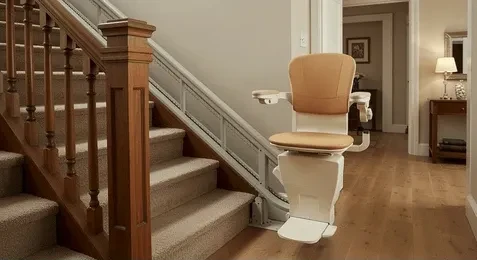
The stairlift features that matter most are the ones that match how you move and how your home is laid out: a swivel seat so you can step off safely, a footrest and rail that fold away if space is tight, a seat belt, easy controls and a battery that charges reliably. Everything else is a nice extra. Here is a checklist you can take to a survey, with notes on who benefits from what.
Safety features to expect on every lift
These should not be treated as optional extras. Ask the installer to confirm each one for the lift on your quote.
- Seat belt. Essential. Check you can fasten it easily and that it is comfortable. If you have limited hand strength, try it at the survey.
- Safety edges. Sensors that stop the lift if something blocks the rail or footrest.
- Soft start and stop. The lift eases into and out of movement rather than jolting. This matters most if you have painful joints, balance problems or a tendency to feel dizzy.
- Key switch. Lets you lock the lift so children or visitors cannot use it. Useful in a family home or if grandchildren visit.
- Safe braking. Stairlifts must meet BS EN 81-40, which includes braking if power is lost.
Seat features
Swivel seat
A swivel turns the seat towards the landing so you can get on and off without twisting on the stairs. It is one of the most important features for most people. It usually works either automatically at the top, or by a lever. If you are tall, unsteady, or use a stick, a powered swivel can feel much easier than a manual one.
Seat height and width
Seat height matters if getting up from a low seat is hard, and width matters for comfort and weight. Standard seats suit many people, but if you are larger or heavier, read our guide to heavy duty stairlifts and weight limits, because the standard limit is not the same for every lift. Some seats can be fitted lower or higher, and some armrests fold up for easier transfers.
Armrests and padding
Padded armrests and a supportive back are worth trying in person. Ask to sit on a lift if you can, even for a minute. A seat that looks fine in a brochure can feel different when you have a bad hip.
Footrest and rail features
Folding footrest: manual or powered
A footrest folds up when you are not using it, so it does not stick out into the hall. Manual folding is simpler and usually cheaper. A powered footrest folds at the touch of a button, which suits anyone who finds bending down hard. If you have arthritis in the hands or knees, it is worth considering.
Folding or slim rails
A folding rail tips up at the bottom of the stairs so it does not block the front door or the hall. That is important in narrow hallways, which are common in Victorian terraces in places like the Dutch Quarter and New Town. A slim profile helps too. If space is tight, our article on stairlifts for narrow stairs goes through the options.
Diagonal or parked positions
Some lifts can park at an angle, or around a corner, so that the footrest is not in the way when someone else walks past. Straight stairlifts are usually parked in line with the rail. Curved lifts may need special parking positions, which depend on the geometry of your stairs. Our look at straight or curved stairlifts helps explain why.
Controls and power
- Control type. A joystick on the armrest suits people with good dexterity. A paddle or rocker switch can suit weaker hands. Ask to try the one you will be given.
- Remote call controls. Small handsets let anyone send the lift to the other end of the stairs. They are most useful for people who live with a carer or partner who may need to move the lift out of the way.
- Battery backup. Most lifts are battery powered and charge at the ends of the rail, so they usually keep working in a power cut. Always park it on its charge point so it tops up.
- Quiet drive. A quiet motor is a benefit if you share a house with someone who sleeps while you ride, or if you simply dislike noise. It is difficult to judge from paperwork, so ask for a demonstration.
Which features matter for which user
| If you... | Prioritise |
|---|---|
| Have painful hips or knees | Soft start and stop, powered swivel, padded seat, adjustable height |
| Have arthritis in the hands | Easy-grip controls, powered footrest, remote call |
| Live in a narrow hall | Folding rail, folding footrest, slim profile |
| Share the home with children | Key switch, tidy parking position |
| Live in an area with power cuts | Good battery, reliable charging contacts |
| Are heavier or taller | Heavy duty option, wider seat, check weight limit |
If you cannot sit comfortably or bend your knees, a different type of lift may suit you better. A standing or perching stairlift is one alternative, and it is covered in more detail in our guide on standing and perching stairlifts.
Features that add cost
More features mean a higher price and more parts that could need repair later. It is sensible to be honest about what you will use. A powered footrest and powered swivel are worthwhile if you have limited strength. They are less so if you are fit and mainly want a stairlift as a precaution. If you are on a budget, a simple, well-fitted lift with a seat belt, swivel and folding footrest often does the job.
The type of lift also changes the price more than extras do. New straight lifts start at about £2,475 installed, and curved lifts at about £4,500. Our stairlift types overview explains what each kind includes as standard.
Questions to take to the survey
- Which of these features are included in the quoted price, and which are extras?
- Can I try the controls and the seat before I decide?
- Where will the lift park, and will it block the stairs for others?
- What is the weight limit, and how wide is the seat?
- Which features can be added or changed later?
We advise across all major brands and we do not push a single feature set. If you would like someone to measure your stairs and talk through the options, you can book a free home survey. There is no obligation.
Frequently asked questions
What stairlift features are essential?
A seat belt, safety edges that stop the lift if something blocks it, soft start and stop, and reliable battery charging. A swivel seat is also important for most people because it makes getting off at the top much safer.
Do I need a powered swivel and powered footrest?
Not always. They help if you have weak hands, painful knees or find bending difficult. If you are strong and mobile, manual versions are simpler and cost less to buy and repair.
Can a stairlift fold away when it is not in use?
Yes. Most lifts have a folding seat, armrests and footrest, and many rails can also fold at the bottom of the stairs to keep a hallway clear. Ask what the folded width will be on your staircase.
Which stairlift features help in a power cut?
Battery power is the main one. The lift is driven by rechargeable batteries that charge at the ends of the rail, so it usually carries on working if the mains fails. Always park it on its charge point.
stairlift featuresswivel seatfolding railstairlift controls
More in Choosing a stairlift
- Stairlift services: the complete guide
- Heavy Duty Stairlifts: Weight Limits Explained
- New or Reconditioned Stairlift: Which Is Better Value?
- Stairlift or Home Lift: Which Is Right for Your House?
- Stairlifts for Chalet Bungalows, Bungalows with Loft Rooms and Dormer Homes
- Stairlifts for Narrow Stairs: What Actually Fits?
- Stairlifts in Listed Buildings and Conservation Areas
- Standing and Perching Stairlifts Explained
- Straight or Curved Stairlift: Which Do I Need?