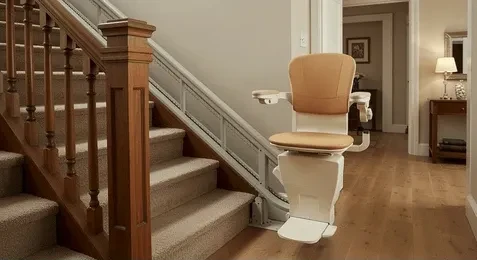
Most narrow staircases can take a stairlift. As a rough guide, installers look for a straight staircase at least 700mm (about 27.5 inches) wide, and around 800mm if the stairs curve. Below that, you will have fewer models to choose from, but options still exist.
Why width is the first question
There is no minimum width for domestic staircases in UK building rules, so nobody can promise your stairs were built with a stairlift in mind. Homes built after about 2010 generally have around 800mm clearance, which usually works. Older homes are a lottery.
That matters in Colchester. The Victorian terraces of New Town and the Dutch Quarter, and many older cottages out towards Dedham, often have steep, tight stairs that were never meant to carry a seat and a rail as well as a person. The good news is that tight stairs are usually workable. What changes is which model suits you and how the rail is positioned.
The two measurements that decide it
Stair width is only half of it. There are two numbers worth thinking about.
- Stair width. The tread length from wall to bannister. Measure it at the narrowest point, not the bottom step.
- Your own sitting depth. A seated stairlift turns you side-on to the stairs. The distance from your spine to your knees, or toes if you cannot tuck your feet back, has to fit between the seat and the opposite wall.
A tall person on a tight staircase can fail the second test even when the stairs pass the first. That is why a tape measure alone is not enough.
How installers squeeze lifts into tight stairs
Fold-away parts
Every modern stairlift folds. The seat flips up, the footrest tucks away and the armrests drop flat. On a narrow staircase, the folded width matters more than the width of the lift when you are riding it, because everyone else in the house still has to use the stairs. Some lifts fold the seat and footrest by motor, so nobody has to remember to do it. Many installers aim to leave around 600mm of clear tread once the lift is parked, which is roughly enough for a person to pass without turning sideways.
Perch and standing seats
A perching stairlift raises the seat so you lean rather than sit. Your knees stick out less, so it can solve the spine-to-knee problem on a tight straight staircase. It is not for everyone, since you need to be comfortable half standing for the whole ride. Our guide to standing and perching stairlifts covers who it suits and who should avoid it, and the standing stairlifts page has more on the options.
Hinged rails
If a door opens straight onto the bottom step, a standard rail would run across the doorway and create a trip hazard. A hinged section lifts clear when the seat is parked. On terraces where the front door or lounge door sits right at the foot of the stairs, this small feature often decides whether the lift is liveable.
Straight versus curved on narrow stairs
A narrow single flight is the easy case. The rail is standard, fitting takes a few hours and there is little doubt once the width is measured. Our straight stairlifts start from about £2,475 installed.
Narrow stairs with a bend, half landing or winder are harder. The rail has to be made to follow your exact geometry, and the working width often tightens further right at the corner. Curved lifts start from about £4,500 and need a few weeks between survey and fitting. If you are not sure which side of the line you are on, read straight or curved: which do I need first.
What narrow stairs can cost
The narrower the staircase, the fewer models fit, and fewer choices can mean a premium. Perching models on a straight rail typically cost £2,000 to £3,000, and curved perching models £4,000 to £6,000. A heavy person on narrow stairs faces the tightest choice of all, because wide seats and narrow stairs pull in opposite directions. Our piece on heavy duty stairlift weight limits explains the trade-off.
Worries that come up in older houses
- Lath and plaster walls. The rail is normally fixed to the stair treads, not the wall, so wall strength is rarely the issue.
- Low ceilings at the top of the stairs. Check headroom, particularly for standing models.
- Bannister posts that sit further into the walkway than the rest of the flight. One post can decide whether a seated lift works.
- Doors that swing over the bottom step. These need a hinged rail or a different parking position.
A worked example from a Colchester terrace
Picture a typical Victorian terrace near the Dutch Quarter. The stairs rise steeply from a door in the hall, the bottom step sits almost against the lounge door, and the staircase is on the tight side of 700mm. A seated lift with a standard rail would swing across the lounge door when parked. Here the realistic answers are a hinged rail that lifts clear of the doorway, a lift with a powered folding seat and footrest, or a perch seat if the user can lean comfortably. None of those is exotic, but choosing between them needs someone to measure, sit on the stairs and try the doors. The best choice for one household can be the wrong one next door.
The same thinking applies to a bigger picture. Our full range of stairlift types is worth a look before you narrow anything down, since an outdoor, standing or reconditioned option can sometimes solve a space problem that a standard seated lift cannot.
Why the survey matters more on narrow stairs
On a standard staircase, a small obstruction rarely changes the outcome. On a narrow one, any single detail can. Our surveyor will measure, sit on the stair with you if needed, and tell you honestly if a model will not suit. Book a free home survey or use the contact page.
Frequently asked questions
What is the minimum stair width for a stairlift?
As a rule of thumb, about 700mm for a straight staircase and about 800mm for a curved one. Some slimline or perching models can work on narrower stairs, but the choice shrinks and the price can rise.
Can other people still use the stairs when a stairlift is fitted?
Yes. The seat, armrests and footrest fold away when the lift is parked, leaving the stairs usable. On very narrow stairs a surveyor will check how much clear width is left.
Will a stairlift damage the walls in an old Colchester house?
The rail is normally bolted to the stair treads, not the wall, so plaster and wall strength are rarely a concern. The survey will flag anything unusual.
Is a perching stairlift better for narrow stairs?
Often it is, because your knees stick out less. It only suits you if you can lean or half stand comfortably for the whole journey, so check with your occupational therapist or GP.
narrow stairsstairlift widthperching stairliftVictorian terrace
More in Choosing a stairlift
- Stairlift services: the complete guide
- Heavy Duty Stairlifts: Weight Limits Explained
- New or Reconditioned Stairlift: Which Is Better Value?
- Stairlift Features Checklist: What to Look For
- Stairlift or Home Lift: Which Is Right for Your House?
- Stairlifts for Chalet Bungalows, Bungalows with Loft Rooms and Dormer Homes
- Stairlifts in Listed Buildings and Conservation Areas
- Standing and Perching Stairlifts Explained
- Straight or Curved Stairlift: Which Do I Need?