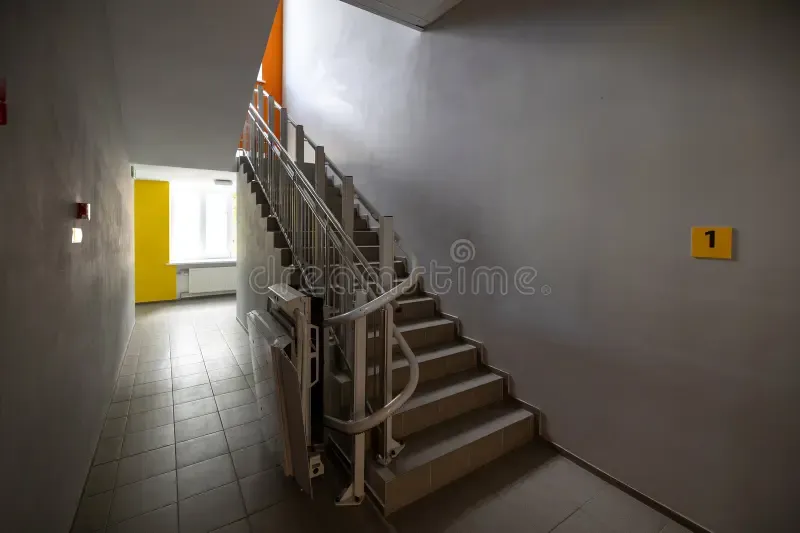
If your stairs run in one unbroken line from the bottom to the top, you need a straight stairlift. If they bend, turn, split at a landing or fan round a corner, you will almost certainly need a curved one. The difference matters because it changes the price by thousands of pounds and the wait by a few weeks.
The quick test you can do at home
Stand at the bottom of your staircase and look up. Ask yourself three things.
- Can I see every step from the bottom to the top without the stairs changing direction?
- Is there a landing, however small, where the flight stops and starts again?
- Do any of the treads narrow to a point as they go round a corner?
Three "no, no, no" answers mean a straight rail. Any other answer means the surveyor needs to look more closely, and that is exactly what a free home survey is for.
When a straight stairlift is the right answer
A straight stairlift runs on a standard rail that is cut to length on the day. Nothing has to be made to measure, which is why it is the cheaper and quicker option. Installation usually takes a few hours, and next-day fitting is often possible depending on availability.
Plenty of Colchester homes fit this description. The classic 1930s to 1960s semi in Prettygate or Mile End usually has one clean flight of stairs, and so do many Victorian terraces in New Town. Newer estates in Myland and Highwoods tend to be straight too, although open-plan designs sometimes add a turn near the top.
New straight lifts start from about £2,475 installed. Most people pay £2,500 to £3,200, and a long or awkward flight can reach £4,500.
When you need a curved stairlift
A curved stairlift has a rail that is built to follow your exact staircase. Any of these layouts will normally call for one:
- A quarter landing turn. The stairs run straight, reach a small square landing, then turn ninety degrees.
- A fan turn. The steps themselves change direction, so the treads are wedge shaped. A straight lift should never finish on a fan turn, because stepping off onto an irregular tread is a real trip risk. A curved lift is the safe choice here.
- A spiral or winding staircase, common in older cottages and converted barns around Dedham Vale.
- Two flights with a half landing, where the stairs double back on themselves.
Some staircases are mostly straight with a single turn near the top or bottom. These can go either way, and the deciding factor is the turn itself. Your surveyor will tell you honestly which option is safer and better value.
The half landing exception
If the landing between two straight flights is level and roomy, it is sometimes possible to fit two straight stairlifts, one on each flight. That can cost less than a single curved rail. The catch is that you have to get off one lift, cross the landing and sit on the next. For someone who is unsteady, that is a lot of extra risk, so it only suits people who can do the transfer safely.
What curved costs, and why
New curved stairlifts start from about £4,500, with £5,500 to £7,000 typical. Multiple turns, half landings or unusual geometry can push the price past £8,000 or £9,000. A modular curved kit costs about £5,250, and a fully bespoke rail about £5,800. Reconditioned curved lifts begin around £4,450, though the saving is smaller than on straight lifts because the rail is usually made new. Our curved stairlift cost guide breaks down where the money goes.
| Type | Typical installed price | Wait |
|---|---|---|
| Straight, new | £2,500 to £3,200 | Often next day, fitted in a few hours |
| Curved, new | £5,500 to £7,000 | A few weeks from survey to fitting |
The wait is the part people forget. Because a curved rail is manufactured after your survey, you are looking at a few weeks before it is fitted. If you are leaving hospital soon, plan for that gap, and ask your occupational therapist about interim arrangements.
Small details that change the quote
A few features show up often on curved jobs. A hinged rail folds away when there is a door directly at the foot of the stairs, so the rail does not run across the doorway. A first step start rail is a neater alternative where there is little floor space at the bottom. Sockets may need adding, and a radiator or pipe run occasionally has to move. None of these is dramatic, but each can add to the bill, which is why a surveyor needs to see the stairs in person.
Width counts too. Narrow stairs limit your choices on both types, and our guide to stairlifts for narrow stairs explains what to expect. And if you are weighing a lift that someone else has already used, read new or reconditioned before deciding.
Common questions we hear at surveys
"Our stairs only turn at the very top. Does that count?" Yes, it still counts as a turn. A single turn near the top or bottom is the classic borderline case. Sometimes the rail can stop just before the turn, and the user steps the last few treads on foot. Whether that is safe depends on how steady you are, how many steps remain and what the treads look like, so it is a decision for the surveyor and you together, not a rule of thumb.
"Can we start with a straight lift and swap later?" Not really. A straight rail cannot be extended round a bend, so if the stairs need a curved lift, the whole rail is replaced.
"Which side of the stairs does the rail go?" On a curved staircase it can sit on the outside of the turn or the inside, and the surveyor picks the better side for safety, headroom and cost. On a straight staircase the choice is usually about which side leaves the most clear space for everyone else.
If cost is the main worry, the survey is also the time to ask about funding. Colchester City Council has a stairlift grant that is not means tested, subject to an occupational therapy assessment and available funds, and we never promise approval.
Next step
Photos help, but a surveyor with a tape measure settles the question in about half an hour. Book a free, no obligation home survey or use the contact page, and we will tell you straight which type your stairs need and what it will cost. You can browse every type on our stairlift types page first if you like.
Frequently asked questions
Can a straight stairlift go round a corner?
No. A straight rail cannot bend, so any turn, fan or spiral needs a curved rail. If the stairs have one level landing, two separate straight lifts are sometimes possible, but you would have to change lifts in the middle.
How long does a curved stairlift take to arrive?
Because the rail is made to measure after the survey, expect a few weeks between survey and fitting. A straight stairlift can often be fitted the next day, depending on availability.
Why is a curved stairlift so much dearer?
The rail is custom made for your staircase, which means more design, more manufacturing and a longer fitting. That is why new curved lifts start from about £4,500 against about £2,475 for a straight one.
Can I tell which type I need from a photo?
A photo gives a good clue, but it cannot show exact angles, door positions or ceiling heights. A free home survey gives you a definite answer and a fixed quote.
straight stairliftcurved stairliftstaircase typeslandings
More in Choosing a stairlift
- Stairlift services: the complete guide
- Heavy Duty Stairlifts: Weight Limits Explained
- New or Reconditioned Stairlift: Which Is Better Value?
- Stairlift Features Checklist: What to Look For
- Stairlift or Home Lift: Which Is Right for Your House?
- Stairlifts for Chalet Bungalows, Bungalows with Loft Rooms and Dormer Homes
- Stairlifts for Narrow Stairs: What Actually Fits?
- Stairlifts in Listed Buildings and Conservation Areas
- Standing and Perching Stairlifts Explained