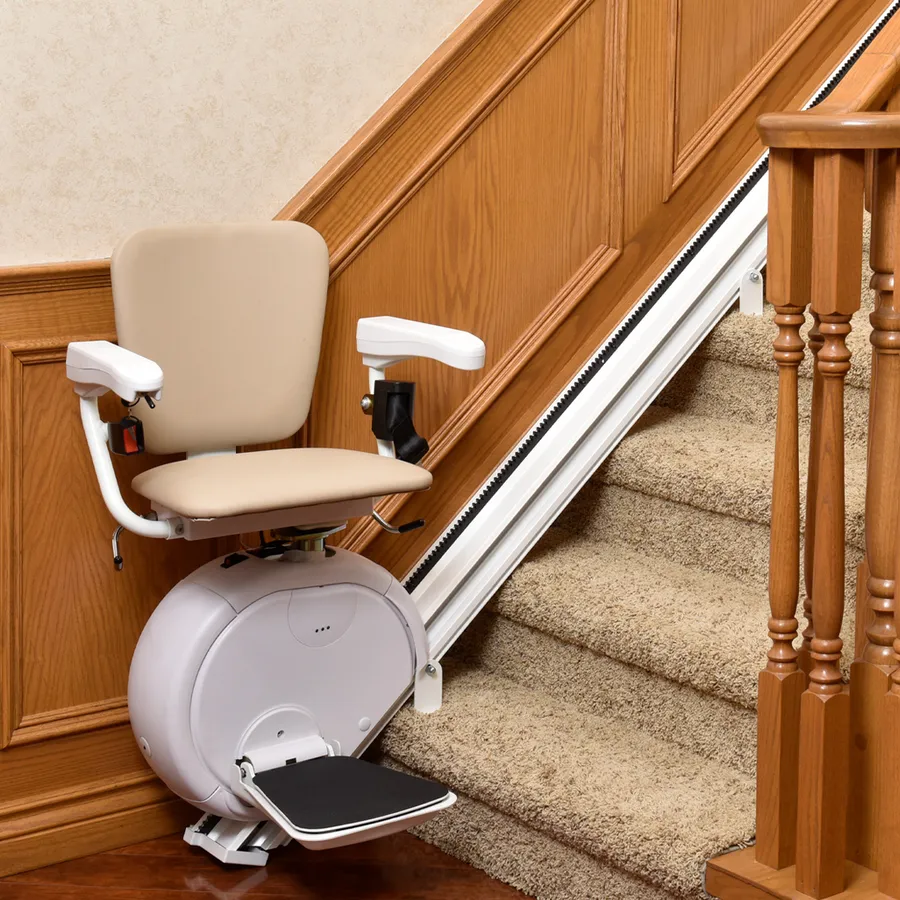
A standing or perching stairlift lets you ride the stairs in a semi-upright position, leaning against a raised seat instead of lowering yourself into a normal chair. It suits people whose knees or hips will not bend far, and it is a poor choice if balance or dizziness is your main problem.
What a perching stairlift actually is
The name causes confusion. Some people picture a platform you stand on while the lift climbs with no seat at all. That is not what is sold for UK homes. A UK standing stairlift, also called a perch or sit-stand model, has a footplate and a high, shallow seat. You stand on the footplate with a slightly bent knee and rest your bottom against the ledge. The seat height can be adjusted for different users.
There are two styles:
- Perch stairlifts have a small angled seat you lean against.
- Sit-stand stairlifts have a seat that rises to near standing height, so there is less lowering and lifting at either end.
Both are available for straight and curved stairs. On curved stairs the rail design is usually a twin rail.
Who they suit
A perching lift is worth asking about if any of this sounds familiar:
- You have had a hip or knee replacement and cannot bend the joint beyond a certain angle.
- Arthritis makes getting up from a low seat painful.
- A physiotherapist or GP has told you to avoid deep bending of the hips or knees.
- You tried a standard seat and found it uncomfortable.
- Your stairs are narrow and a full seat sticks out too far. A perch seat tucks your knees back. Our guide to stairlifts for narrow stairs goes into this.
Recovery is a common reason in Colchester. After a hip or knee operation, the stairs at home are often the biggest obstacle to coming out of hospital. If the need may be short term, it is worth reading new or reconditioned, since a reconditioned or rental lift can make sense for a temporary need.
Who should not use one
Be honest with yourself here, because this is where perching lifts go wrong.
- Severe balance problems or dizziness, including conditions such as Meniere's disease, BPPV or labyrinthitis. You are upright for the whole ride.
- Anyone who cannot stand or half stand safely for the length of a staircase. Seated lifts are better.
- Neuromuscular conditions or low blood pressure. Speak to your GP first.
- Very tall users with low ceilings. You are riding higher up the staircase, and many Colchester houses have ceilings that dip over the bottom or top step. Headroom needs checking.
We do not give medical advice. If you are not sure, an occupational therapist can assess you on your own stairs. Our guide to the occupational therapy assessment in Essex explains how to arrange one.
Space and weight
Perching lifts need a staircase of at least about 700mm for most models, with around 500mm of clear floor at the bottom for parking. Some can fit tighter with adjustments, but that is a job for a surveyor. They have slightly larger footplates than seated lifts, but they fold away neatly.
Weight limits are usually lower than for a seated lift, since your weight bears down on the footplate. Check the exact limit for the lift you are quoted. If you need a higher limit, see our heavy duty stairlift weight limits guide.
What they cost
Standing and perching stairlifts cost slightly more than a basic seated model. Our installed prices are:
| Staircase | Typical installed price |
|---|---|
| Straight standing or perching | £2,000 to £3,000 |
| Curved standing or perching | £4,000 to £6,000 |
Running costs are low. Like other stairlifts they charge on the rail or at a charge point, and the electricity used is minimal. Annual servicing is still worth doing. If you or the user qualify as chronically sick or disabled, the stairlift can be supplied with 0% VAT instead of 20%, which you confirm by signing a declaration of eligibility. See our stairlift cost page for the full calculator.
What it feels like to use one
You step onto the footplate, lean back onto the raised seat and fasten the belt. The footplate and seat then carry you up the stairs at a gentle, steady speed. At the top you step off and the unit folds up. The movement you avoid is the deep bend of the hips and knees needed to drop into a normal seat and push back up again, and that is exactly the motion that hurts after surgery or with arthritis.
There is a downside worth stating plainly: you stay on your feet for the full journey, and a long staircase makes that a longer wait. If you tire quickly, or your legs are weak rather than stiff, a seated lift may actually be the more comfortable choice. That is why we suggest trying the posture on your own stairs before committing. It is also worth thinking about everybody else in the house, since a taller footplate and seat can sit differently when folded. The wider range of stairlift types is on our services page if you want to compare.
How to decide
If sitting is the problem, try before you buy. At your free survey the surveyor can show you the seat height and let you rehearse the posture on your own staircase. Take your time, and bring whoever helps you at home. You can read more on our standing stairlifts service page, then book a free home survey or use the contact page.
Frequently asked questions
What is the difference between a standing and a perching stairlift?
They are very close. A perching lift has a small angled ledge you lean on. A sit-stand model has a seat that rises to near standing height. Both leave you with a bent knee rather than a fully seated position.
Is a standing stairlift safe if I have poor balance?
Usually not. You are upright throughout the ride, so severe balance problems or dizziness make a normal seated stairlift the safer choice. Ask your GP or occupational therapist.
How much does a standing stairlift cost in Colchester?
A straight standing or perching lift typically costs £2,000 to £3,000 installed, and a curved one £4,000 to £6,000. Your survey gives a fixed price for your stairs.
Can I get a standing stairlift if I am heavy?
Weight limits are often lower than on seated models because your weight sits on the footplate. A surveyor can check the limit of the exact lift, and heavy duty seated models exist as an alternative.
standing stairliftperching stairliftsit-stand stairlifthip replacement
More in Choosing a stairlift
- Stairlift services: the complete guide
- Heavy Duty Stairlifts: Weight Limits Explained
- New or Reconditioned Stairlift: Which Is Better Value?
- Stairlift Features Checklist: What to Look For
- Stairlift or Home Lift: Which Is Right for Your House?
- Stairlifts for Chalet Bungalows, Bungalows with Loft Rooms and Dormer Homes
- Stairlifts for Narrow Stairs: What Actually Fits?
- Stairlifts in Listed Buildings and Conservation Areas
- Straight or Curved Stairlift: Which Do I Need?