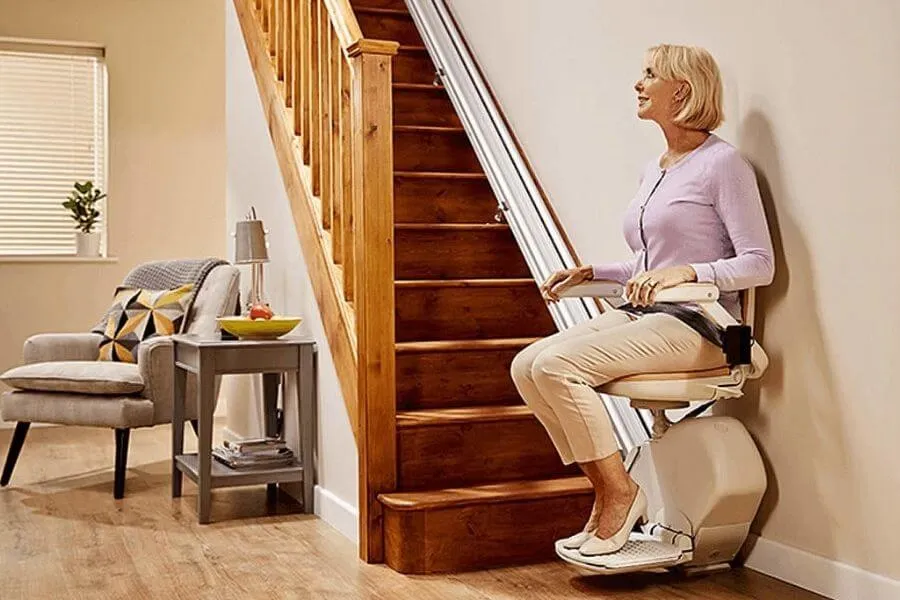
For most people who can sit and stand safely, a stairlift is the better choice: it costs far less, goes in within hours and needs no building work. A home lift (through-floor lift) makes sense when you use a wheelchair full time, cannot transfer onto a seat, or expect your needs to grow.
What each one is
A stairlift is a seat on a rail fixed to your stairs. You sit at the bottom, ride up and step off at the top. It uses the staircase you already have.
A home lift, sometimes called a through-floor lift, is a small lift car that moves vertically through an opening cut in the ceiling. Some carry a seated or standing passenger. Larger ones take a wheelchair user, with or without a carer. When the car is downstairs, the opening above is closed off by the roof of the car.
Side by side
| Stairlift | Home lift | |
|---|---|---|
| Installed cost | From about £2,475 straight; from about £4,500 curved | From about £14,000, with aperture and installation |
| Building work | None | Ceiling opening, electrics, making good |
| Fitting time | A few hours (straight) | Several days, plus surveys and approval |
| Floor space | None, just the stairs | Space in two rooms, stacked |
| Wheelchair users | Must transfer to the seat | Wheelchair models, no transfer |
Cost: the biggest gap
A new straight stairlift typically costs £2,500 to £3,200 installed, and a curved one £5,500 to £7,000. A home lift starts from about £14,000 including the aperture and installation, and that assumes one floor of travel. Building work is usually extra, and larger wheelchair models and tricky layouts cost more. Servicing a home lift is also dearer than servicing a stairlift.
That price difference shapes everything else. Our stairlift cost calculator gives you a ballpark for the stairlift side. Reconditioned or rented stairlifts bring the price down further, and the new or reconditioned comparison covers when that is wise.
Space and building work
A stairlift takes no floor space. The seat, arms and footrest fold, and on a narrow staircase there is usually a model that fits. Our narrow stairs guide has detail.
A home lift needs two rooms that line up above each other. The most compact types tuck into a corner at roughly 1,200mm by 800mm, but wheelchair models need more. The space above must be free of joists, pipes or a bathroom that cannot move. The pay-off is that the staircase is left completely clear.
It is a building project. The ceiling is cut, floor joists may be trimmed, a dedicated power supply may be needed, and both rooms need making good afterwards. That work will usually need building control approval from the local council. A survey comes first, and you should expect several days on site. A stairlift, by contrast, is bolted to the stair treads and fitted in a few hours.
Wheelchair users
This is the question that should drive the decision, more than price.
If you can transfer safely from a wheelchair to a seat, a stairlift can work well. Many people keep a second wheelchair upstairs. It is a practical and far cheaper arrangement, but it does depend on you being able to make the transfer at both ends, every time.
If you cannot, or if you need a carer to travel with you, a lift that takes the wheelchair itself is the safer option. That means a home lift or a platform lift. If your condition is likely to progress, think about the next five years, not just today. An occupational therapist can help you judge what is realistic, and our guide to the OT assessment in Essex explains how to ask for one.
Colchester homes: what usually works
A 1930s semi in Prettygate with a clean straight flight is a textbook stairlift case. A Victorian terrace in New Town may have narrow, steep stairs, but ground-floor rooms rarely line up well for a home lift, so a stairlift is still usually the easier route. Larger Edwardian villas in Lexden sometimes have the room for a home lift, and for a wheelchair user that may be the better long-term answer. Newer builds in Myland often have rooms stacked tidily, which helps.
Selling later, and funding
A stairlift leaves only small screw holes in the treads when removed. A home lift leaves a hole in the ceiling to fill and two rooms to redecorate, although some buyers see an installed lift as a plus. Our guide to selling or removing a stairlift goes through the stairlift side.
VAT at 0% can apply to both, for someone who is chronically sick or disabled, on a self-declaration. Local funding generally goes to the option that meets assessed need at the lowest reasonable cost, so if a stairlift is suitable, that is normally what is recommended. We never promise a grant.
Questions to ask yourself
- Can I walk a few steps and sit down and stand up safely, with or without a little support? If so, a stairlift is likely to do the job.
- Do I use a wheelchair all day, or will I soon? Then a lift that takes the chair deserves serious thought.
- Are two rooms stacked directly above each other, with room for a lift and no pipes or joists in the way?
- Is the money better spent elsewhere, for example on a downstairs bathroom or a ramp?
- How long do I expect to stay in this house?
There is also a middle path some households take: a stairlift now, with a plan to revisit a home lift if needs change. The stairlift can be removed later with little fuss. Our wider range of stairlift types and lift options sits on the services page.
Next step
If you are not sure which way to go, the honest answer comes from someone looking at your stairs and your mobility. Book a free home survey or use the contact page.
Frequently asked questions
How much does a home lift cost compared with a stairlift?
A home lift starts from about £14,000 including the aperture and installation, with building work extra. A new straight stairlift starts from about £2,475 and a curved one from about £4,500.
Can a wheelchair user have a stairlift?
Yes, if they can transfer safely to the seat. Many people keep a second wheelchair upstairs. If you cannot transfer, a lift that carries the wheelchair is safer.
Does a home lift need building work?
Yes. An opening is cut through the ceiling, an electrical supply is often needed and the rooms are made good afterwards. Building control approval is usually required.
Which is quicker to fit?
A stairlift, by a long way. A straight one is usually fitted in a few hours and often within days of ordering, while a home lift needs surveys, approval and several days of work.
home liftthrough floor liftwheelchair liftstairlift
More in Choosing a stairlift
- Stairlift services: the complete guide
- Heavy Duty Stairlifts: Weight Limits Explained
- New or Reconditioned Stairlift: Which Is Better Value?
- Stairlift Features Checklist: What to Look For
- Stairlifts for Chalet Bungalows, Bungalows with Loft Rooms and Dormer Homes
- Stairlifts for Narrow Stairs: What Actually Fits?
- Stairlifts in Listed Buildings and Conservation Areas
- Standing and Perching Stairlifts Explained
- Straight or Curved Stairlift: Which Do I Need?