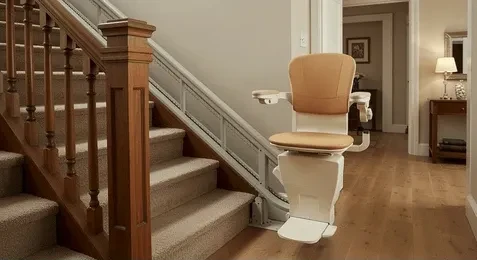
Get your stairlift serviced once a year. A stairlift is a battery, a motor, a drive mechanism and a set of safety sensors, and all of them wear gradually. A scheduled check is cheaper and quicker to arrange than a repair after a breakdown, and it keeps your warranty or service plan valid.
How often does a stairlift need servicing?
Once a year is the general rule for normal home use. If several people share the lift, or it runs far more than a handful of trips a day, six-monthly visits are worth considering. Reconditioned lifts deserve a slightly closer eye in their first year or two, so a check around six months in is sensible. Our comparison of new and reconditioned stairlifts has more on that.
Servicing is not a legal requirement for a home stairlift. But it is usually a condition of keeping any warranty or service plan, and skipping it raises the chance of a breakdown at the worst moment.
What an engineer checks
The visit covers the things you cannot easily see or test yourself. Expect roughly 30 to 45 minutes for a straight lift, a bit longer for a curved one.
- Battery. Tested under load, not just switched on. A battery can hold a surface charge while being close to failure.
- Drive mechanism. Inspected for wear and lubricated. This is the gear or chain that moves the carriage along the rail.
- Safety sensors. Each one is tested to confirm the lift stops when it meets an obstruction.
- Rail and fixings. On curved rails, the joints where the rail changes angle carry more stress and are the first place misalignment shows.
- Seatbelt, footrest and armrests. Working checks on the folding hinges, controls and belt.
- Charging. That the lift docks properly at its charge points.
Stairlifts must meet BS EN 81-40, the safety standard for construction and installation, and the service is partly about checking that those features still work as designed. If you want to understand the parts, our explanation of stairlift batteries and power cuts covers the power side.
What servicing costs
Prices depend on whether the lift is straight or curved, whether you pay per visit or hold a plan, and whether the manufacturer limits who can service its equipment. Curved lifts take longer to check, so they cost more. If you pay separately, annual servicing on a curved lift runs roughly £280 to £320. Straight lifts are usually less, and we will quote you for your own lift. Emergency and out-of-hours call-outs cost more than booked daytime visits, and parts are billed on top of labour.
A service plan that includes priority call-out often works out cheaper than paying for each breakdown. If your lift was bought VAT-free under the disability relief, servicing and repairs should stay zero-rated while the same eligible person uses it, so mention it when you book. Our repairs and servicing page lists what we offer for all major brands.
What you can do between visits
A few simple jobs make a difference, and none needs tools.
- Wipe the rail now and then with a dry cloth. Dust, hair and household debris can interfere with smooth running.
- Keep the top and bottom parking areas clear so the lift can dock and charge. A coat on the bannister or a bag on the bottom step is a surprisingly common cause of problems.
- Fold the seat, arms and footrest after use, so nobody trips and nothing snags.
- Check the charge indicator or light when you park.
- Keep the key, if your lift has a key switch, somewhere safe. It lets you control who uses the lift, which matters if grandchildren visit.
Leave everything mechanical and electrical to a qualified engineer. Adjusting the drive, sensors or wiring yourself risks your safety and your warranty and saves little.
Warning signs to act on
Do not wait for the annual visit if something changes. Call us if you notice:
- grinding, clicking or a whine that was not there before;
- the seat slowing or hesitating at one spot on the rail;
- the battery indicator dropping faster than it used to;
- jerking at the start or end of the ride instead of a smooth movement;
- the lift failing to line up with its charging point when parked.
Batteries commonly last around three to five years before they need replacing, so a lift that loses charge quickly is one of the clearest early warnings. A failing battery can leave you stuck part way up the stairs, which is why it is worth a phone call.
Choosing a servicing provider
You do not have to use the firm that fitted your lift. Many engineers service all major brands, but a few manufacturers restrict who may work on their equipment, so ask before you book. A good provider will tell you in advance what is included, whether parts are extra, how quickly they can attend a fault and whether the engineers are DBS checked, which matters when someone is entering your home. Keep a simple log of dates, the engineer's name and any work done. It helps if you claim on a warranty, and it reassures a buyer if you sell the house. Our own engineers are DBS checked, and we are members of the British Healthcare Trades Association.
Finally, make a note in your diary a month before the annual visit is due. It is easy to forget a service when the lift is working perfectly, and that is exactly when it is cheapest to check.
When repair becomes replacement
Most faults on a looked-after stairlift are small and cheap. Occasionally, usually past the ten-year mark, a quote comes close to the price of a replacement. At that point ask directly whether repairing still makes sense. An honest engineer will say so. If you decide to retire the lift, see selling or removing an old stairlift.
Book a service in Colchester
We service and repair stairlifts across Colchester and the surrounding villages, whoever fitted them. See our installation and aftercare page for the full picture, or use the contact page.
Frequently asked questions
How often should a stairlift be serviced?
Once a year for normal domestic use. If the lift is shared by several people or used very heavily, consider six-monthly visits.
How much does it cost to service a stairlift?
Paid separately, annual servicing on a curved lift is roughly £280 to £320. Straight lifts are generally less, and we will give you a firm price for your own lift.
Can I service my own stairlift?
You can wipe the rail and keep the parking areas clear. Mechanical and electrical checks need a qualified engineer, for safety and to protect your warranty.
What are the signs my stairlift needs attention?
New noises, hesitation on the rail, jerky rides, a charge that drains faster than before, or poor docking at the charge point. Call for a check rather than waiting.
stairlift servicingstairlift maintenanceannual servicestairlift repairs
More in Installation and aftercare
- Stairlift installation: the complete guide
- How Long Does Stairlift Installation Take?
- Preparing Your Home for a Stairlift Installation
- Selling or Removing an Old Stairlift
- Stairlift Batteries and Power Cuts: What Happens?
- Stairlift Not Working? Safe Checks Before You Call for Repairs
- What Happens at a Free Stairlift Survey?