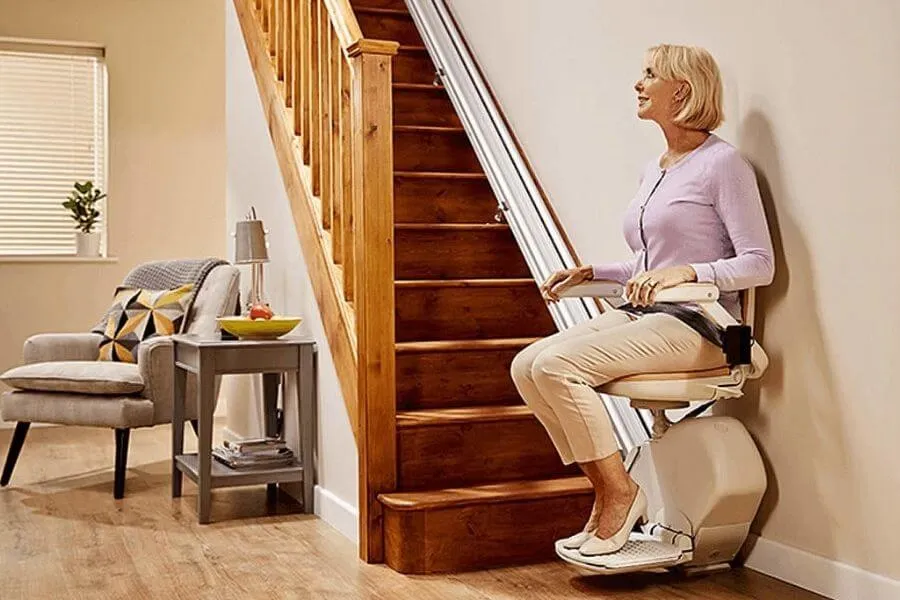
If you are chronically sick or disabled and the stairlift is for your own home, you can usually buy and have it installed at 0% VAT instead of 20%. You do this by signing a declaration. The saving is one sixth of the VAT-inclusive price, so about £1,100 on a £5,500 curved lift. Nobody else decides your eligibility: it is your own declaration.
This guide explains how that works in plain terms. It is general information, not tax advice, and the rules can change, so always check the official wording before you sign.
What the saving looks like
Because the quoted price includes 20% VAT, removing it takes off one sixth of the figure you see. A few examples using our 2026 price ranges:
| Lift | Price with VAT | Approximate saving at 0% |
|---|---|---|
| New straight, entry level | £2,475 | About £410 |
| New straight, upper typical | £3,200 | About £530 |
| New curved | £5,500 | About £1,100 |
| Complex curved | £8,000 | About £1,330 |
These are estimates. Your own quote should show the VAT treatment clearly, and the final figure depends on your staircase. For the wider price picture, see what a stairlift costs in the UK in 2026.
Who can use the 0% rate
The reduced rate is aimed at people who are chronically sick or disabled, buying and installing a stairlift for personal use in their own home. In practice, that is the person who will ride the lift, or someone buying on their behalf for them to use.
The key thing to understand is that eligibility is the buyer's own declaration. We cannot decide it for you, and neither can your installer or a salesperson. You read the criteria, decide whether they describe you, and sign if they do.
If you are unsure, it can help to talk to your GP or an occupational therapist about your circumstances, though they will not make the VAT decision for you either. If you are going through the council's grant route, our post on the occupational therapy assessment in Essex explains what the visit covers.
How the process usually works
- You get a quote. It should show the price before VAT, the VAT and the total, or state that VAT is zero rated if you are eligible.
- You are given a declaration form. It asks you to confirm that you are chronically sick or disabled and that the equipment is for your own use.
- You read it and decide. There is no pressure to sign, and if you do not meet the criteria, you pay the standard rate.
- You sign and return it. The supplier keeps it on file as part of their records.
- Installation goes ahead. The invoice shows VAT at 0%.
It is a form, not an application. There is no waiting for approval from HMRC.
What to check on GOV.UK and with HMRC
Because this is a legal declaration, the exact wording matters more than any summary written by a stairlift company, including this one. Look at the GOV.UK pages on VAT for disabled people and the equipment they use, or contact HMRC directly, to see the current definitions of "chronically sick or disabled" and which items qualify. Search GOV.UK for VAT relief for disabled people rather than relying on a third-party link.
Points worth checking there:
- The official definition of chronically sick or disabled.
- Whether the relief applies to the equipment, the installation, or both.
- Whether anything changes if the lift is bought by a relative or a carer.
- What happens if the lift is later sold or passed on.
A worked example
Say you are quoted £2,900 for a new straight stairlift, with VAT at 20% included. Divide by six and you get about £483, which is the VAT element. If you are eligible and sign the declaration, the price you pay drops to roughly £2,417. On a £7,000 curved lift, the same sum gives a VAT element of about £1,167. The percentage is the same, but the cash difference grows quickly with the more complex staircases, so it is worth understanding before you compare quotes from different suppliers. Make sure each quote states clearly whether it includes VAT at 20% or at 0%, otherwise you are not comparing like with like.
Common mistakes and cautions
Assuming it is automatic
It is not. You have to ask for the form, and your quote may be shown at 20% until you do.
Assuming it covers everything
The relief applies to the installation of the stairlift itself. Other costs, such as servicing in later years, are treated differently. Ask what applies to your particular purchase.
Signing when you are unsure
If you are not sure that you qualify, do not sign. The declaration is yours, and so is the responsibility for getting it right.
VAT relief and other ways to pay less
The VAT saving stacks neatly with other options. You can combine 0% VAT with a reconditioned stairlift, or with rental, or with council help if you qualify. Our guide to paying for a stairlift without a grant sets out all of these routes, and the Colchester stairlift cost page has a calculator for a first estimate.
On a short-term need, such as recovery after an operation, rental might also reduce what you pay. We compare the two in renting versus buying a stairlift.
Asking us about it
When we quote, we show the VAT position clearly and give you the declaration form to read at your own pace. You can ask us questions about the process any time, but we will not tell you whether you qualify. To start, book a free home survey.
Frequently asked questions
Who can claim 0% VAT on a stairlift?
People who are chronically sick or disabled and are buying a stairlift for their own home can declare eligibility for 0% VAT. It is a self-declaration, so you decide whether the official criteria apply to you. Check the wording on GOV.UK or with HMRC first.
How much does VAT relief save on a stairlift?
You save one sixth of the VAT-inclusive price. On a £5,500 curved lift that is about £1,100, and on a £2,500 straight lift it is about £415.
Does the stairlift company decide if I qualify?
No. The supplier cannot decide eligibility. They give you a declaration form and you sign it if you believe you meet the criteria.
Can I get VAT relief and a council grant together?
They are separate things. The VAT declaration is about the tax on the price, while a grant is about help with paying. Ask the council how any grant interacts with your final invoice.